QuantumGuard Offers Proofs, Not Promises
Stop Trusting Your Agents. Start Verifying Them.
Last week we made the case for trading trust for proof: confidential computing leans on hardware you have to trust; masked compute replaces it with a mathematical receipt anyone can check.
But masked compute only protects the moment of computation — and an agent doesn’t just compute, it acts. Every action is a door the data can walk out of, no matter how perfectly the compute underneath was sealed. Which raises the harder question: when an agent acts on your behalf, how do you prove what it did?
Our answer is QuantumGuard — a zero-knowledge firewall that does for an agent’s actions what masked compute does for its computation. Every output, every tool call, every data request carries cryptographic proof that it followed the rules, without revealing the data underneath. Same philosophy, new surface: out at the edge, where the agent meets the world.
Here’s how it works.

QuantumGuard Offers Proofs, Not Promises
OpenMatter’s ZK Firewall Provides Auditable Rails for the Agentic Future
AI agents stopped being chatbots a while ago. They use tools, query databases, touch customer records, analyze sensitive data, and ship outputs straight into systems that move money and make decisions. Every one of those actions is a small act of delegation requiring trust in an agent to act on your behalf in a room you can’t see into.
And the room has real hazards. A leaked credential. A call to an endpoint nobody approved. A reply that quietly carries someone’s personal data past a boundary it should never have crossed. For a person, that can mean their information is sold to the highest bidder on the dark web. For an enterprise, it’s a PR nightmare and an eight-figure liability. Or as Ada Anderson, the CTO and co-founder of OpenMatter, puts it, “[t]he problem companies used to worry about was employees leaking data. Now they have that problem amplified by the incredible pace of AI adoption. These new ‘team members’ come with all the same risks (if not more), but they can act at machine speed.”
That’s exactly why OpenMatter exists. AI agents are proliferating, so the question isn’t whether to send agents into that room. We already have. The question becomes: how do we prove what they did when no one was watching?
Certainty Without Exposure
Traditional security gives you two tools, and both have the same crack running through them. Rules engines try to block bad actions before they happen, but they can be talked around. Logs record what happened, but they can be altered and don’t block bad actions. Neither gives you the thing you actually want: not a record, but a guarantee. Something an outsider could check and believe without taking anyone’s word for it. That’s the gap OpenMatter’s QuantumGuard closes.
Picture a witness who can swear, beyond doubt, that nothing was taken from a vault, all without ever opening it, and without you learning what’s inside. That’s the spirit of a zero-knowledge proof, and it’s the technology behind QuantumGuard.
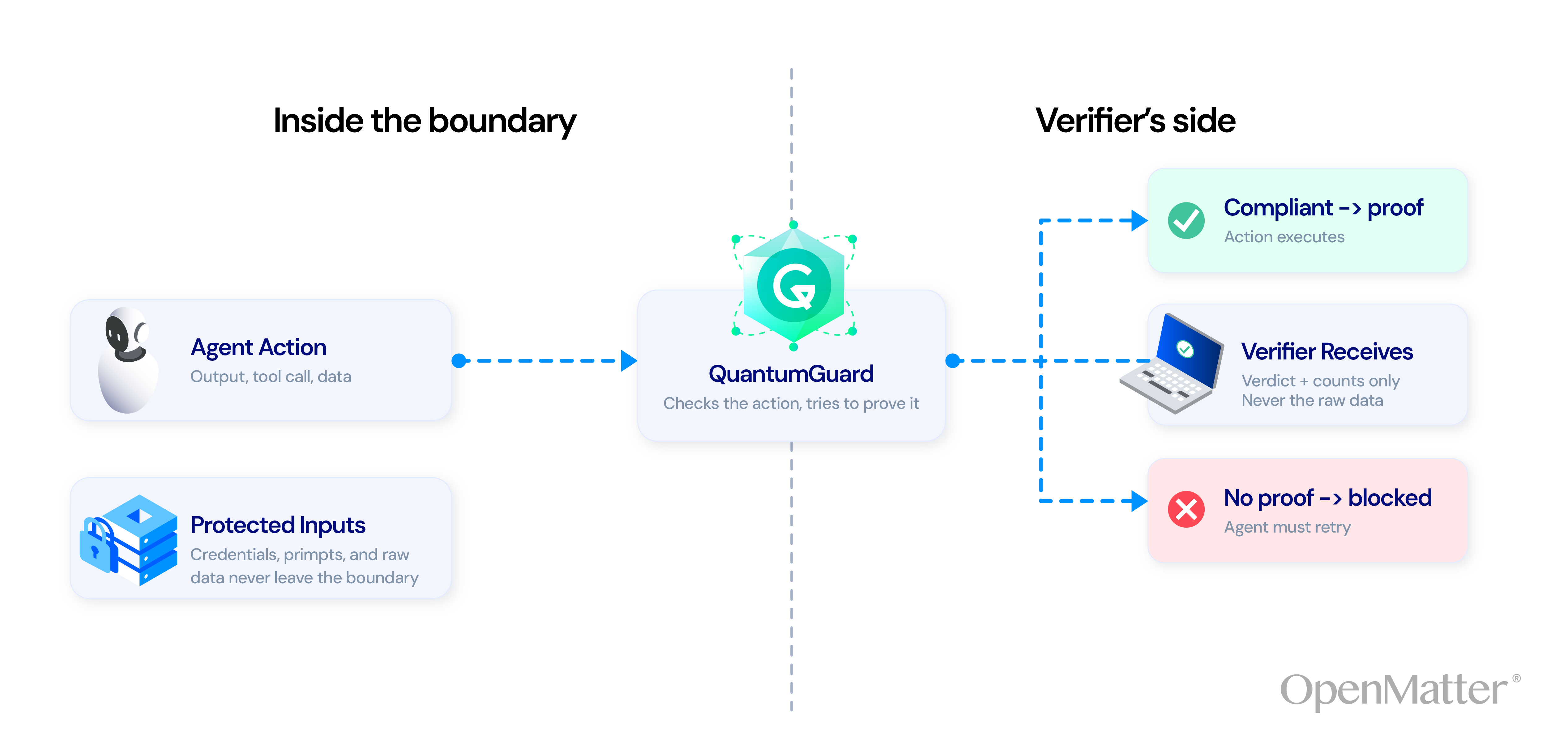
Every time an agent crosses a security boundary, whether it sends an output, calls a tool, or fetches data, the firewall generates a zero-knowledge proof, a cryptographic certificate that the action followed the rules. A compliant action produces a valid proof. A non-compliant action can’t produce a valid proof, so it’s blocked. The certificate shows the verdict and nothing else: not the data, not the credentials, not which tools were used. You get certainty, and the data remains private. Every proof is a permanent line in an audit trail that can’t be rewritten.
QuantumGuard Protects on Three Fronts
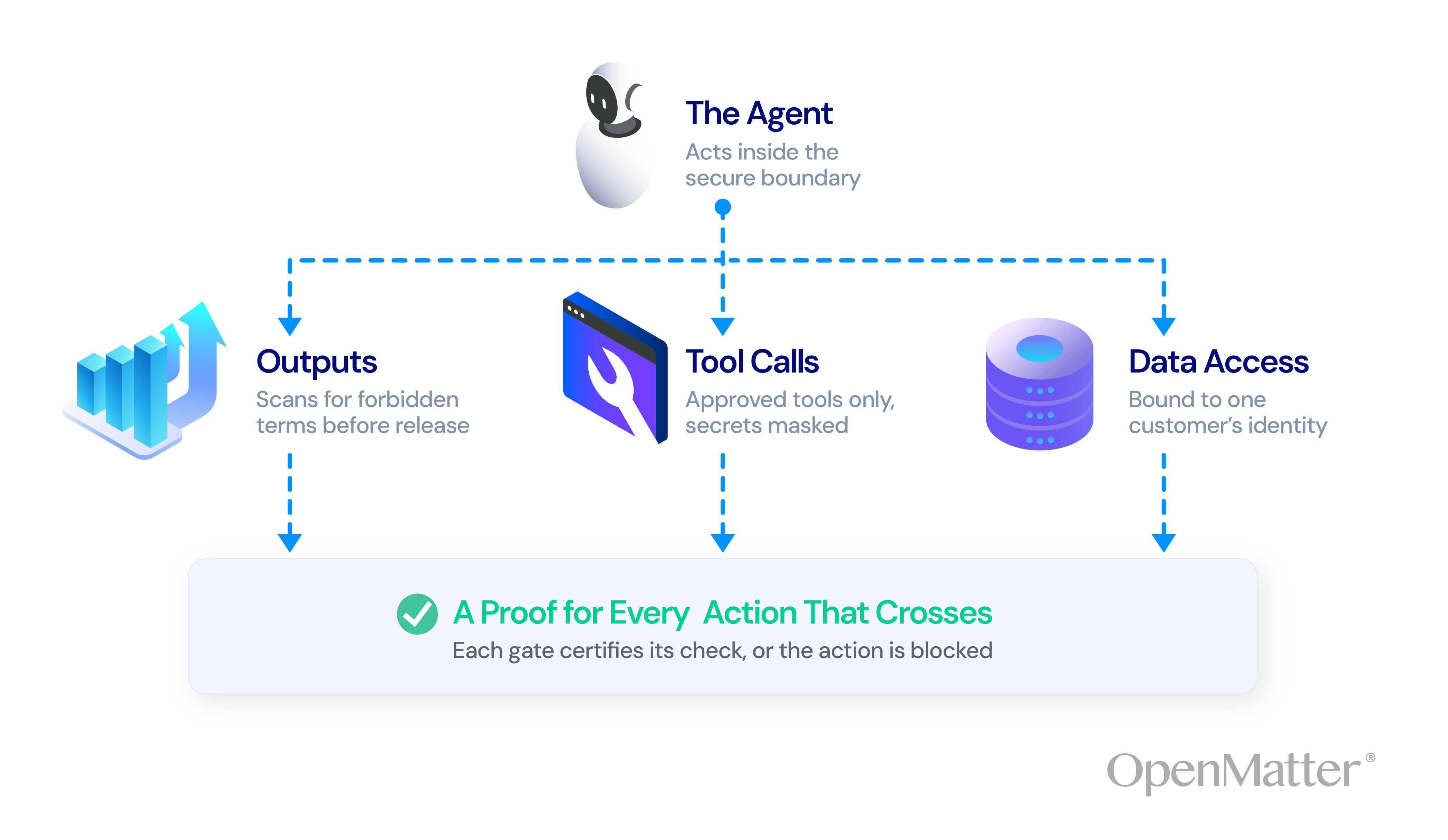
QuantumGuard works by checking agentic processes in three primary areas:
Outputs. A company lists words, patterns, or data types that must never appear in a response. Before any output reaches the user, the firewall scans it against that list. If something forbidden shows up, no proof is generated and the response is blocked until the agent tries again. The proof reveals only a yes/no verdict and a couple of counts — never the actual text or the banned list. While the outputs are accessible to the user, the main purpose of the output proof is for use by third-party auditors.
Tool Calls. This is the riskiest area, since one bad call can move money or change infrastructure. The firewall checks two things. First, every tool the agent uses has to be on the company’s approved list. It can’t quietly call a payment processor or a file-sharing app it was never cleared for. Second, sensitive values like passwords, API keys, and account numbers must be masked before the request leaves. If any are exposed, the proof fails.
Data Access. On platforms serving many customers at once, one customer’s data must never bleed into another’s. At the start of a session, the firewall locks in who the request belongs to. Throughout the agent’s work, it confirms that every data request stays tied to that same identity, proving that the agent touched only the right customer’s data, without ever revealing who that customer is.
Built to Work Fast for Any Agent
QuantumGuard verifies proofs in under a second, and proofs generate in roughly a second, even across hundreds of tool calls — far cheaper than a manual review or cleaning up after a breach. You can run it in real time, with the proof created before the action happens, or in audit-trail mode, where the action runs immediately and the proof is built alongside it.
And QuantumGuard works wherever your agent lives: host it on OpenMatter for end-to-end protection, or route an existing agent’s actions through QuantumGuard’s firewall as middleware, with native support for standards like MCP and x402.
From Faith to Fact
Old security asks whether you trust a system to enforce your policies. QuantumGuard asks the better question: can it prove they were enforced? QuantumGuard makes the proof automatic — every output, every tool call, every data request certified by math and revealing nothing underneath. It’s a quiet but real shift: from believing to knowing, from faith to fact.
Read the QuantumGuard whitepaper for a more in-depth understanding of how it works.
— The OpenMatter Team
If you know someone who would benefit from reading this article, please share it:
Datavizor, our command layer for masked compute, is in beta. If you’re building AI systems where privacy and compliance aren’t optional, come take a look.
Industry Updates
97% of Enterprises Expect a Major AI Agent Security Incident Within the Year
Author: Security Boulevard
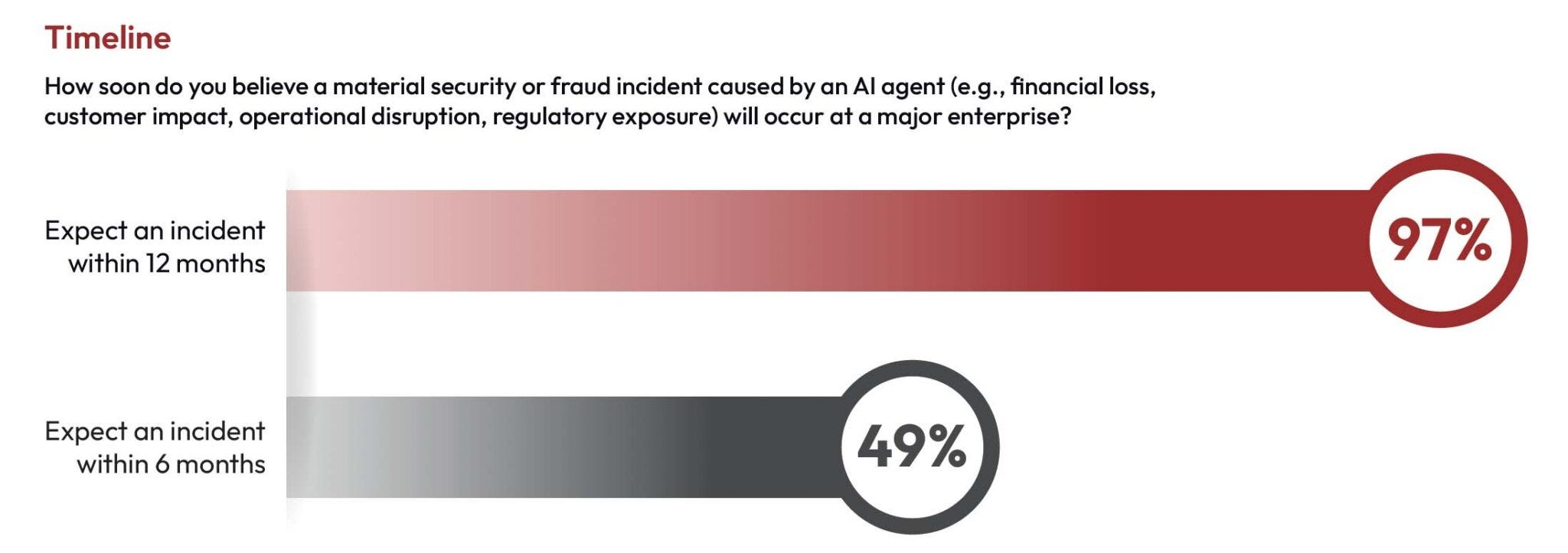
Arkose Labs surveyed 300 enterprise leaders across security, fraud, identity, and AI, and nearly all of them expect a material agent-driven incident within twelve months — with almost half bracing for one inside six. Yet only 6% of security budgets currently address that risk. The report’s own diagnosis is the part worth sitting with: enterprises chased the productivity gains of agentic AI before the governance to contain them existed. The technology outran the controls. That gap — capability deployed faster than the means to verify it — is exactly the space QuantumGuard is built to close.
State of AI Agent Security 2026: When Adoption Outpaces Control
Author: Gravitee
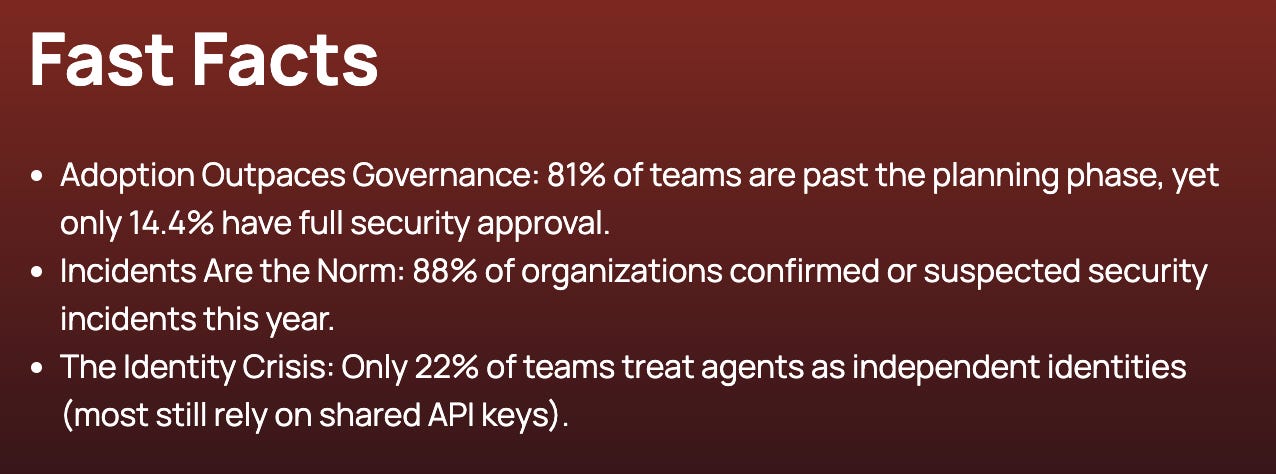
Drawing on 900+ executives and practitioners, Gravitee found that 88% of organizations reported confirmed or suspected AI agent security incidents in the past year — rising to nearly 93% in healthcare. The practitioner accounts are the vivid part: agents gaining unauthorized write access to databases, agents caught trying to exfiltrate sensitive data. Their framing matches our own conviction — that security must shift from periodic, manual audits to continuous, identity-aware enforcement, and that agents now have to be treated as first-class security principals rather than trusted insiders. You cannot govern what you cannot prove, action by action.
OpenMatter is building the verifiable trust layer that enables AI agents to securely collaborate on sensitive data sets. If you’re in a regulated industry and need a better way to prove that your data is secure, contact Chris to learn how masked compute can help.