
Today we are thrilled to announce the launch of the OpenMatter Newsletter. A newsletter about the future of the agentic economy and data privacy.
Meaningful coordination, whether between two scientific researchers, two tier-1 banks, or a swarm of autonomous AI agents, is structurally impossible when it comes to handling raw, proprietary data. Organizations want to collaborate, but they can’t compromise on privacy.
The Necessity of Privacy-Preserving Compute
Solving this deadlock requires a new technical primitive: privacy-preserving compute. It is the ability to analyze data, train models, and extract insights from multiple distributed datasets without ever moving or decrypting the raw information. Historically, organizations had to choose between utility and compliance. By integrating advanced cryptography directly into the infrastructure layer, privacy-preserving compute breaks this dichotomy. It allows completely zero-trust environments to yield high-value, collaborative outputs safely.
The Agentic Economy Has a Trust Problem
AI agents are powerful because they can act. But the moment an agent gets access to sensitive data, credentials, or payment rails, the risk profile changes completely. A useful agent can leak proprietary information, call the wrong endpoint, access the wrong tenant partition, or expose a user’s budget and payment context.
Software guardrails are insufficient for this new environment. Relying on semantic prompts, regex filters, output classifiers, or centralized infrastructure to protect sensitive data does not constitute a robust security model.
Furthermore, the global regulatory landscape has shifted permanently. From the EU AI Act to emerging US federal AI mandates and strict sector-specific data privacy laws worldwide, relying on software promises is no longer legally viable. If we want autonomous systems to operate inside real businesses and real markets, we need mathematical guarantees and auditable compliance.
Introducing OpenMatter Network
OpenMatter Network provides the post-quantum infrastructure for privacy-preserving compute and verifiable agent compliance. Our architecture divides the ecosystem into three distinct environments: the Client Plane (where data owners reside), the Compute Plane (where blind execution occurs), and the Economic Plane (where agents transact).
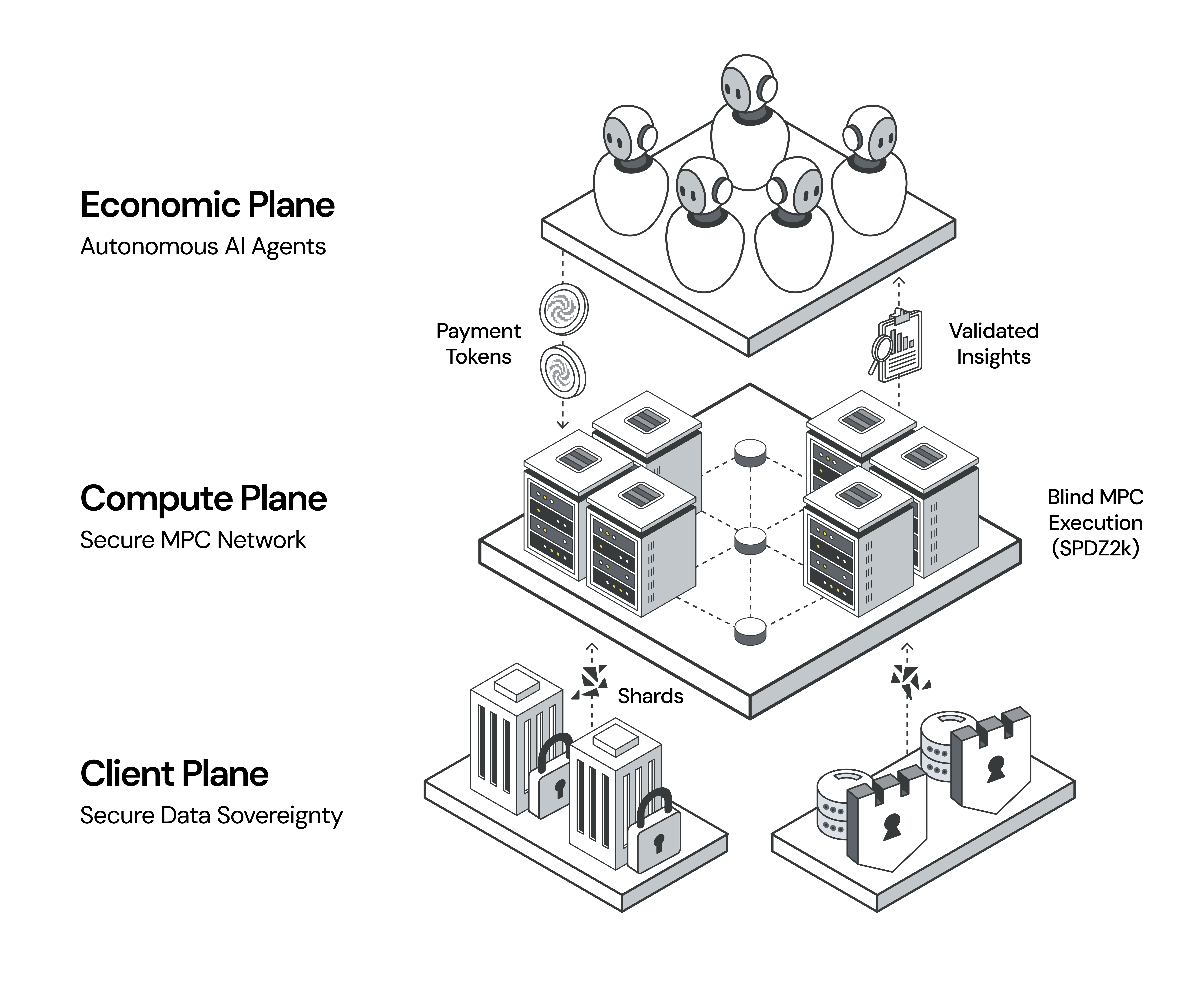
The full stack is divided into two core categories:
1. Masked Computing (Secure Data Collaboration)
Datavizor: The deployment and orchestration layer abstracting cryptographic complexity. Enterprises connect sensitive data sources and define policies through familiar interfaces. Raw data never leaves the Client Plane.
MatterML: Our privacy-preserving machine learning framework. It compiles supported model families into highly optimized Multi-Party Computation (MPC) circuits using the SPDZ2k protocol and lattice-based cryptography, enabling high-speed analysis across distributed datasets without moving the underlying plaintext.
2. Agent Compliance (Verifiable Execution)
Secure Agent Hosting: A sovereign, secure fortress for agents. Agent configurations, credentials, and environment variables are encrypted and protected through post-quantum threshold cryptography. No single provider can access the full secret set or decrypt any data.
ZK Firewall: Cryptographic compliance at the point of action. Before any output is published, any tool is called, or any data is accessed, the firewall generates a zero-knowledge proof that the action conforms to policy. It functions natively for hosted agents or as standalone middleware (BYOA) for agents running on external infrastructure.
What This Looks Like in Practice
Masked Computing for Data Owners
Imagine financial institutions or healthcare networks that need to collaborate on fraud detection or medical research but cannot legally share their ledgers or patient files. With Masked Compute, full data residency is maintained. The data is cryptographically sharded locally, and only meaningless fragments enter the Compute Plane. Organizations achieve fully private collaborative compute without sacrificing compliance.
Agent Compliance for Builders
For developers building agentic workflows, the deployment pathways are flexible. A marketplace can onboard its agents directly into our Secure Agent Hosting layer, ensuring that all API keys and secrets are protected by decentralized threshold decryption.
Alternatively, teams with pre-existing agents and infrastructure do not need to migrate. Using the Bring Your Own Agent (BYOA) middleware mode, developers can route their existing agents through the ZK Firewall. Every output, tool call, and data retrieval passes through a verifiable compliance check. Approved actions move forward, and non-compliant actions are mathematically blocked, injecting zero-knowledge security into your current stack with zero infrastructure migration.
The Resource Provider Ecosystem
OpenMatter is powered by a decentralized network of resource providers. As private ML workloads, secure agent hosting, and ZK proof generation grow, the network needs reliable operators to contribute compute capacity.
We have designed the network so that anyone can participate. Whether you operate an enterprise data center, manage in-house corporate servers, or simply have an idle gaming rig or a Mac Mini at home, OpenMatter gives you a path to put it to work. Resource providers supply the cryptographic horsepower that makes the agentic economy safe, earning passively as agents pay for compute across the network.
Join the Public Testnet
OpenMatter is moving rapidly toward our mainnet launch. Both the ZK Firewall and our Masked Compute environments are officially in testnet development. We’re shipping new cryptographic features daily, and we are now opening the doors for early builders and partners to help shape the future of the network.
Agent marketplaces and agent deployers can request access to ZK Firewall today. We’re already working with early design partners to secure outputs, tool calls, and cross-tenant data access across agentic commerce and enterprise AI workflows.
Financial analysts, research institutes, healthcare, and insurance networks can explore the early capabilities of Masked Compute within our sandboxed testnet to collaborate without moving raw data.
If you have idle hardware, you can register as an early node operator or compute provider. We are actively onboarding resource providers to help power secure hosting, private ML workloads, and proof generation as we scale the network.
The future of the web is agentic. The foundation must be secure. OpenMatter exists to make that security auditable and performant.
Onboard now! https://onboard.openmatter.network